Monday, August 28, 2006


Golden Kettle Photostory
Photos by Gustavo Montes de Oca
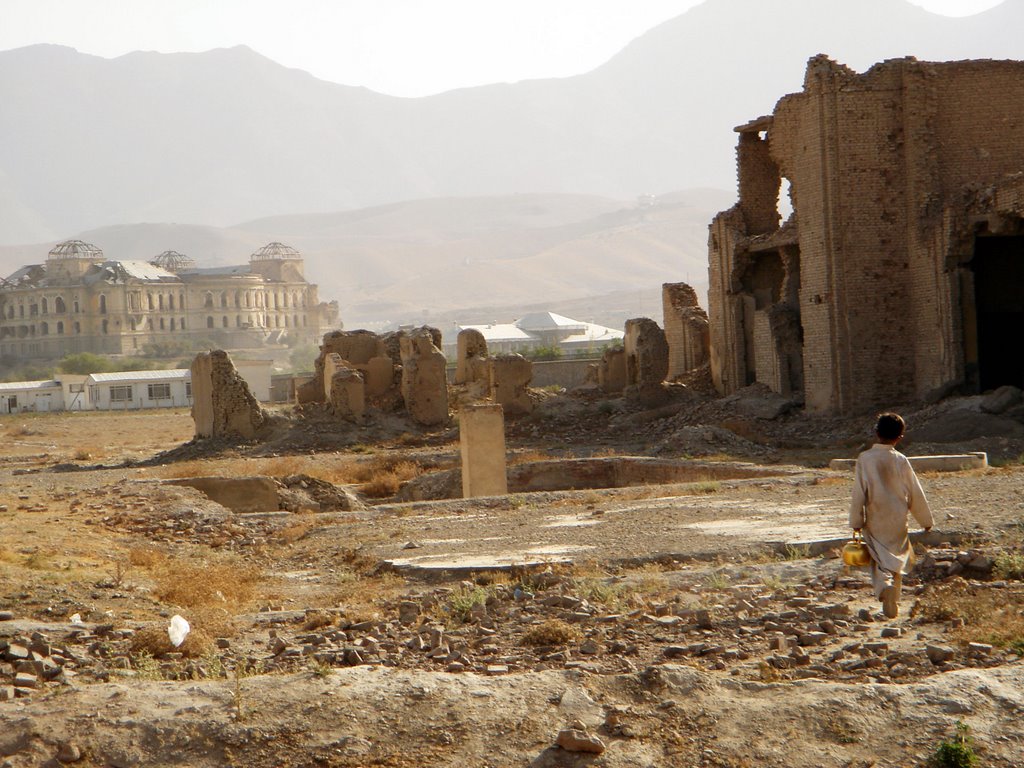
In West Kabul there is a street that rival factions faught over, taking turns occupying or bombing. A majestic palace stands on a hill looking down the long street, once perhaps a grand march or promenade. Now the palace looks like the shell whose snail died a long time ago. Decorative plasterwork has been remodelled by bullets. Round windows have turned into gaping holes by rocket attacks. Its sweeping approach road curling up the gentle hill has deep bomb craters. There are sandbags in some of the french windows. Columns start at the floor but come to a jagged end short of the ceiling. Once a place to welcome and house important people (more research to come), there is a forbidding ring of razor wire around it. Signs in four languages warn visitors not to take photos. They fear it could be used once again as a staging post for attacks; this time against the Canadian and American army bases in the plains below.
Within sight of the palace there is the wreck of a government building. Inside that wreck live destitute families. We talked to one whose previous accomodation was a tent in Kabul Stadium, but with the return of sporting competitions, they were left homeless again. They have endured two bitter winters in the shell of a building. There are no doors and no windows. Walls and roofs have been blasted apart. This is scarcely shelter.
The family of 15 live in what used to be the kitchens for the civil servant canteen. They have a dog, a rug, a quilt, two mattresses and a pillow, a television powered by a car battery, cutlery, a gas ring, a pot, and a golden kettle.

They have so little, but when we walk in, they offer us tea. Najibullah is sent to fetch water from the pump. To get there he has to clamber through a rocket hole in the wall and over barbed wire. He has to clamber over rubble and to the neighbouring ruins of a block of flats where at least 250 other people live and share the pump. There he has to fend off the other children fighting for the water, pleading with them that he needs tea for guests.
He makes the journey back while his father scavenges sugar from another family in the complex. The baby the father carries is naked, has a distended belly, and a cluster of flies around an open wound on its arm. It stops crying when both its arms are firmly around his 22 year old fathers neck, or it is cramming sugar sweets into its mouth. His mother knows its bad for his teeth, but it keeps him quiet.

Najibullah fires up the gas ring and stands guard over it while his father entertains Jamie, welcoming him onto the riased concrete platform where the red quilt is offered as a seat. The setting sun streams through the damaged walls.
Najibullah pours a little boiling water into the glass mugs to clean them. His father comes to collect the kettle and the black tea leaves. The younger generation has done its bit for hospitality, now the head of the household takes over.
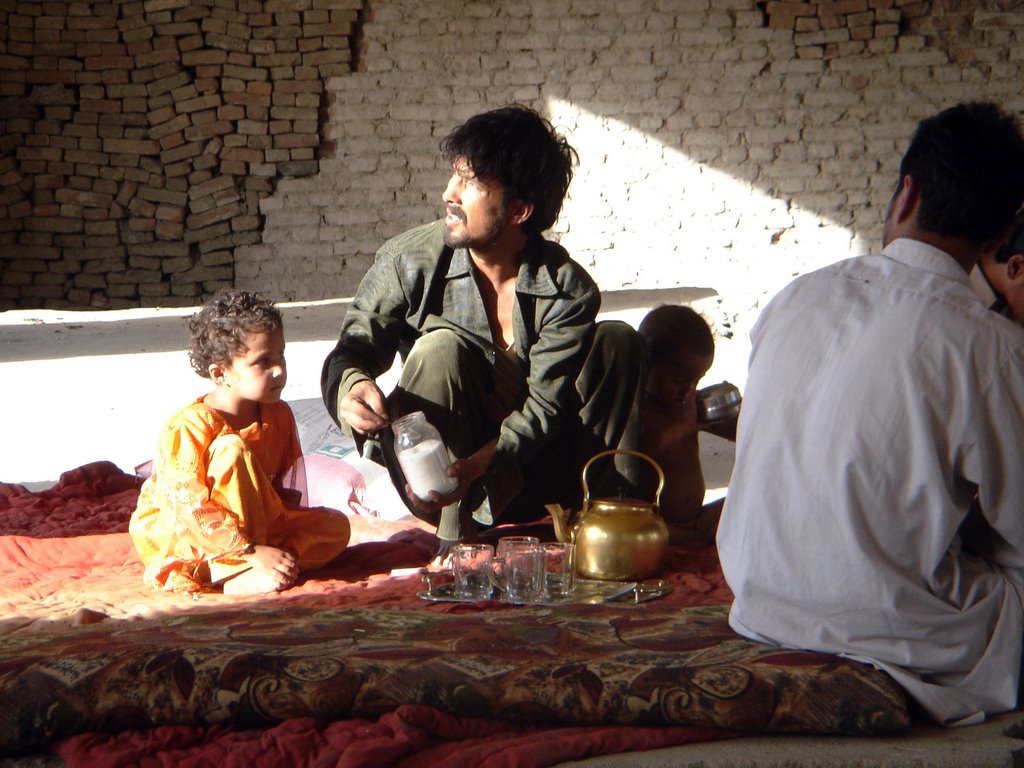
Father asks if we want sugar, it is a luxury he doesn't own.As soon as any glass approaches its last sips, he tops it up, then pats the naked childs tiny bum because as his fathers attention shifted, hed begun to cry.
They have nothing, and they made us tea. In a gold teapot.
I am crying.
Friday, August 25, 2006
Speen Ghar Hotel
In Jalalabad we stayed at the hotel where Osama met journalists. These are my not so factual impressions.
Thursday, August 24, 2006
Photo : Beekeepers Bike
 Pimp my Bike
This here is a bicycle. All the bicycles here are the same chinese model.This one belongs to one of 90 returnees being trained in beekeeping as a source of income. It is much needed.
Bike Geeks note the brake levers connect to solid bars rather than wires, it all runs on levers and pivots. Tree Geeks note it is leaning on an orange tree. Camera geeks note Jamie's Canon 20 D in the background.
Photo: Rickshaw
 Pimp my Rickshaw
We could of course afford an amoured convoy of humvees like the ones we saw on the Kabul-Jalalabad road, but this keeps things a bit more undercover. This night there was a kidnapping in the city so after finishing with the refugees, we counted ants at the hotel.
Photo: Refugee Trucks
 Pimp my truck
These trucks are stopping at an encashment center aka. A UNHCR help point where refugees are given medical care, mine awareness lessons! (welcome home- watch your step), necessaries, and cash for transport and set up costs. Jamie and I rode on top of the cabin.
Drips and Drabs from the last few days
We visited a school for the blind and disabled. Click this
We rode on the roof of a truck returning 27 refugees to a land some of them had never seen but still claimed as their own. They left
We had driven in a UNHCR convoy to a township near Jalalabad. A township is a number of houses built by the returnees on land the government gives them. Here refugees had what they all clamour for: A piece of the country they haven't seen in 25 years. This plot of land was sandwiched between a dried river bed and a minefield. The nearest village, and school, refuses to have a connecting road built. There are few jobs if any. There is a culture of asking the relief agencies for more, but surprisingly little desire to help each other or help themselves. An ex-teacher moans about the lack of a school. I suggest he teach. He laughs.
Despite these difficulties, I was surprised by how developed the site was. I had expected ramshackle huts and tents; but here, using local techniques and the few things their land has a bounty of, stone and dirt, the families had within a year, constructed their 2 bedroom houses and many had erected walls demarcating their plots. The more senior residents had even added refinements to the design like guttering and decorative patterns.
The border with
16 wheeler trucks carrying mundane containers are elaborately decorated. Each Panel along the side is framed with flowers and bright coloured paintings of idyllic homes by rivers. Inside each frame fit three florid letters. MER.CED.ESB.ENZ.GER.MAN.YSU.PER.DEL.UXE.MDL.2004
We are waiting for a truck of refugees to come by so we can ride with them. We sit in an office dodging flies and nodding in agreement to the incoherent Pashto declarations of an Ex- Afghan Army soldier. He did the compulsory three years and got out. Or maybe, they let him go. His iris doesn't touch the sides of his eyes and his hands are possessed.
Our translator waits until he's comfortable with us to express his discomfort at certain traditions. He looks embarrassed when he admits his wife wears a burka. When I ask if he talks about it with her he is restored and says he does. Apparently. Its pretty hot underneath a head to toe sheet.
Drivers: You take your life in your own hands when you cross the road. You put your life in the driver's when you get in a car. You need an expression like Inshallah (if god wills) to keep you at ease.
Akmal, our driver, has a Pakistani made car, so the steering wheel is on the wrong side. To see if it is safe to overtake he has to swing the car fully into the oncoming lane. Eventually I scavenge enough Dari from the dictionary to devise a message relaying system. Apparently. Shouting woooah, is not a universal sign of danger get back in your lane. Now.
Subscribe to:
Posts (Atom)